PLUMEDΒΆ

PLUMED is an open-source, community-developed library that provides a wide range of different methods, which include enhanced-sampling algorithms, free-energy methods, tools to analyze the vast amounts of data produced by molecular dynamics (MD) simulations. These techniques can be used in combination with a large toolbox of collective variables that describe complex processes in physics, chemistry, material science, and biology. Documentation, examples and installation instructions for the various packages are discussed on the PLUMED website.

Path integral metadynamics
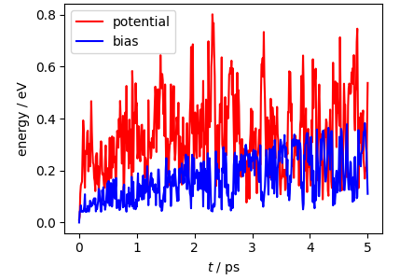
This example shows how to run a free-energy sampling calculation that combines path integral molecular dynamics to model nuclear quantum effects and metadynamics to accelerate sampling of the high-free-energy regions.
Path integral metadynamics
ML collective variables in PLUMED with metatomic
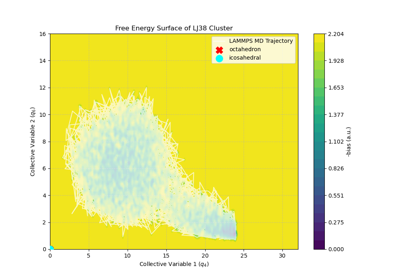
This example shows how to build a metatomic model that computes order parameters for a Lennard-Jones cluster, and how to use it with the PLUMED package to run a metadynamics simulation.
ML collective variables in PLUMED with metatomic
Computing the pKw of water with a machine-learning potential
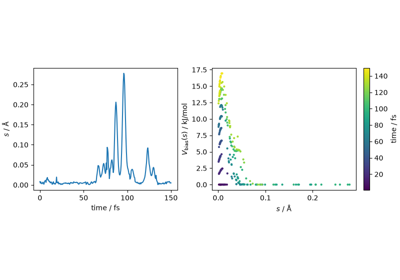
The autoionization of water, \mathrm{2H_2O \rightleftharpoons H_3O^+ + OH^-}, is the prototypical acid-base equilibrium, and its equilibrium constant K_\mathrm{w}=[\mathrm{H_3O^+}][\mathrm{OH^-}]/(c^\circ)^2 (\mathrm{p}K_\mathrm{w}=-\log_{10}K_\mathrm{w}=13.93 at 300 K) sets the scale of every \mathrm{p}K_\mathrm{a} and \mathrm{p}K_\mathrm{b}. Computing it from first principles is a stringent test of a simulation protocol, because it combines several ingredients that are each worth one or more pK units if neglected: a reactive potential, collective variables that follow the proton as it hops between molecules, enhanced sampling of a free energy of about 32\,k_\mathrm{B}T, a well-defined relation between the free-energy profile and the equilibrium constant, the long-range Coulomb interaction of the products in a small periodic box, and the quantum nature of the nuclei.
Computing the pKw of water with a machine-learning potential