torch-pmeΒΆ

torch-pme provides a modular implementation of classical algorithms for the evaluation of long-range interactions (e.g. Ewald, particle-mesh Ewald - PME, and P3M). It can be used to build traditional electrostatic models, as well as long-range descriptors for machine-learning applications.

Atomistic Water Model for Molecular Dynamics
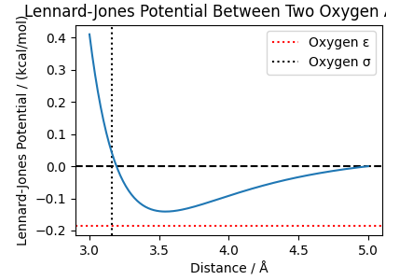
In this example, we demonstrate how to construct a metatomic model for flexible three and four-point water model, with parameters optimized for use together with quantum-nuclear-effects-aware path integral simulations (cf. Habershon et al., JCP (2009)). The model also demonstrates the use of torch-pme, a Torch library for long-range interactions, and uses the resulting model to perform demonstrative molecular dynamics simulations.
Atomistic Water Model for Molecular Dynamics
Learning Capabilities with torchpme
This example demonstrates the capabilities of the torchpme package, focusing on learning target charges and utilizing the :class:`CombinedPotential` class to evaluate potentials that combine multiple pairwise interactions with optimizable weights.
Learning Capabilities with torchpme
Computing the pKw of water with a machine-learning potential
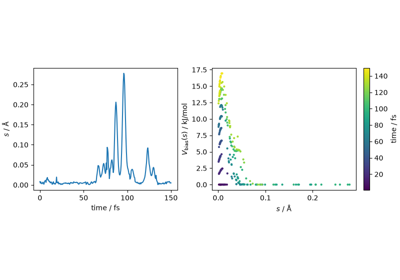
The autoionization of water, \mathrm{2H_2O \rightleftharpoons H_3O^+ + OH^-}, is the prototypical acid-base equilibrium, and its equilibrium constant K_\mathrm{w}=[\mathrm{H_3O^+}][\mathrm{OH^-}]/(c^\circ)^2 (\mathrm{p}K_\mathrm{w}=-\log_{10}K_\mathrm{w}=13.93 at 300 K) sets the scale of every \mathrm{p}K_\mathrm{a} and \mathrm{p}K_\mathrm{b}. Computing it from first principles is a stringent test of a simulation protocol, because it combines several ingredients that are each worth one or more pK units if neglected: a reactive potential, collective variables that follow the proton as it hops between molecules, enhanced sampling of a free energy of about 32\,k_\mathrm{B}T, a well-defined relation between the free-energy profile and the equilibrium constant, the long-range Coulomb interaction of the products in a small periodic box, and the quantum nature of the nuclei.
Computing the pKw of water with a machine-learning potential