Note
Go to the end to download the full example code.
Machine-learned dipoles and infrared spectroscopy of liquid water
- Authors:
Paolo Pegolo @ppegolo
This recipe shows how to combine a machine-learning interatomic potential (MLIP) with a machine-learned dipole model to compute the infrared (IR) spectrum of liquid water.
The workflow has four steps:
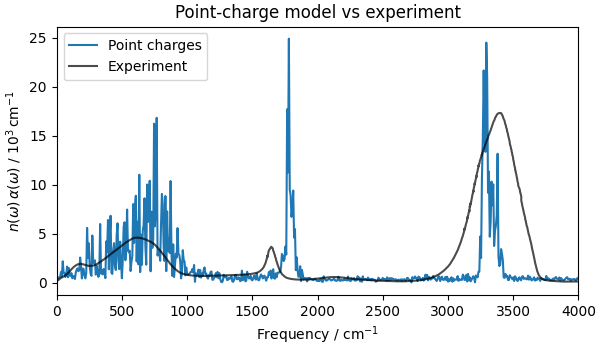
Point-charge baseline: compute the dipole time series from a TIP3P trajectory with fixed atomic charges; identify where this approach fails.
Training: fine-tune the PET-MAD-XS foundational MLIP on a small water dataset with an added dipole output head, using metatrain.
Simulation: run a new NVT trajectory driven by the joint MLIP.
Spectrum: evaluate ML dipoles along the trajectory and compare against the point-charge baseline and experiment.
Along the way we discuss equivariance, the symmetry constraint that any dipole model must satisfy, and quantify how well an unconstrained architecture satisfies it.
# sphinx_gallery_thumbnail_number = 4
from zipfile import ZipFile

import ase.build
import ase.io
from ase.geometry import get_distances
import chemiscope
import matplotlib.pyplot as plt
import numpy as np
import scipy.signal
import yaml
from atomistic_cookbook_utils import download_with_retry, run_command
from scipy.spatial.transform import Rotation
from metatomic.torch import ModelOutput
from metatomic.torch.ase_calculator import MetatomicCalculator
/home/runner/work/atomistic-cookbook/atomistic-cookbook/examples/water-ir-spectrum/water-ir-spectrum.py:42: DeprecationWarning: Importing MetatomicCalculator from metatomic.torch.ase_calculator is deprecated and will be removed in a future release. Please import from metatomic_ase instead.
  from metatomic.torch.ase_calculator import MetatomicCalculator
Data and model downloads
All data and model files are included in a single zip archive, which we download and extract:
download_with_retry(
    "https://github.com/ppegolo/labcosmo_ictp_school/raw/refs/heads/tmp/water-ir-spectrum.zip",  # noqa: E501
    "water-ir-spectrum.zip",
)

with ZipFile("water-ir-spectrum.zip", "r") as z:
    z.extractall(".")
Fixed point-charge dipole model for liquid water
A simple (and simplistic) dipole model assigns fixed partial charges to each atom. We use the TIP3P values \(q_\mathrm{H} = +0.417\,e\) and \(q_\mathrm{O} = -0.834\,e\), which match the force-field charges used in the MD simulation. The total dipole of the simulation cell is then
Note that, as long as charge neutrality is maintained (\(q_\mathrm{O} = -2\,q_\mathrm{H}\)), rescaling all charges by a factor \(k\) maps \(\boldsymbol{\mu}\) to \(k\boldsymbol{\mu}\) and therefore the IR spectrum by \(k^2\). This is a global rescaling that cannot change the relative intensities between peaks, so tuning the charge value is not a meaningful way to improve the shape of the spectrum. For systems that carry a net ionic current (electrolytes, ionic liquids), the zero-frequency limit of the spectrum is proportional to the ionic conductivity, which does depend on the actual transported charge: in that case only formal (oxidation-number) charges yield the correct DC limit, even though they produce incorrect intensities. Here, pure water has zero ionic conductivity, so the choice of charge value is truly nothing else than an overall scale factor.
Under periodic boundary conditions the raw sum \(\sum_i q_i \mathbf{r}_i\) is
gauge-dependent: shifting a
molecule across the simulation box by a lattice vector changes its value. To get a
physically meaningful cell dipole, we unwrap each hydrogen into the minimum-image
frame of its bonded oxygen before summing, using ASE’s minimum-image convention
(mic=True), which handles any cell shape.
def compute_pc_dipole(
    atoms: ase.Atoms, q_H: float = 0.417, q_O: float = -0.834
) -> np.ndarray:
    """
    Total point-charge dipole of a periodic water box (e·Å).
    It assumes that each O is bonded to exactly two H's, and that each water molecule is
    overall charge-neutral.

    :param atoms: ASE Atoms object containing the water box
    :param q_H: partial charge on each H atom in units of e
    :param q_O: partial charge on each O atom in units of e
    :returns: total cell dipole as a 3D vector in e·Å
    """

    q_sum = q_O + 2 * q_H
    assert abs(q_sum) < 1e-6, "Net charge is not zero"

    syms = np.array(atoms.get_chemical_symbols())
    i_O = np.where(syms == "O")[0]
    i_H = np.where(syms == "H")[0]

    # D_vec: shape (n_O, n_H, 3), displacement vectors pointing from O to H
    # D_len: shape (n_O, n_H), scalar distances
    D_vec, D_len = get_distances(
        p1=atoms.positions[i_O], p2=atoms.positions[i_H], cell=atoms.cell, pbc=atoms.pbc
    )

    # For each H (axis 1), find the index of its nearest O (axis 0)
    nearest_o = np.argmin(D_len, axis=0)  # (n_H,)

    # Extract the minimum-image O->H bond vectors
    bond_vec = D_vec[nearest_o, np.arange(len(i_H))]  # (n_H, 3)

    # If the molecules were not neutral, the expression would be
    # dipole = (q_O + 2 * q_H) * atoms.positions[i_O].sum(axis=0)
    #          + q_H * bond_vec.sum(axis=0)
    # The simplified expression for neutral molecules is
    return q_H * bond_vec.sum(axis=0)
By the fluctuation-dissipation theorem, the linear infrared absorption spectrum is proportional to the Fourier transform of the equilibrium dipole-dipole autocorrelation function. In practice this is most easily computed via the power spectral density of the total cell dipole:
where \(\tilde{S}_{\boldsymbol{\mu}}\) is the isotropic two-sided power spectral density of \(\boldsymbol{\mu}(t)\), \(n(\omega)\) is the refractive index, and \(1/6 = (1/3) \times (1/2)\) combines the orientational average (liquid water is isotropic) with the cosine-transform convention. Given a dipole time series sampled at regular intervals, we can compute the power spectral density with scipy.signal.periodogram, which uses a fast Fourier transform (FFT) and is therefore very efficient even for long trajectories:
def ir_spectrum(
    dipoles_eA: np.ndarray,
    dt_fs: float,
    volume_A3: float,
    temperature_K: float = 300.0,
) -> tuple[np.ndarray, np.ndarray]:
    """IR absorption from a dipole time series.

    :param dipoles_eA: total cell dipole in e·Å, shape ``(n_frames, 3)``
    :param dt_fs: time between saved frames in fs
    :param volume_A3: simulation box volume in ų
    :param temperature_K: temperature in K
    :returns: tuple with frequencies in cm⁻¹ and :math:`n(\\omega)\\alpha(\\omega)` in
        10³ cm⁻¹
    """
    c_cms = 2.99792458e10  # cm/s
    kb_J = 1.380649e-23  # J/K
    e_C = 1.602176634e-19  # C
    A_m = 1e-10  # Å to m

    # Convert dipole to SI (C·m)
    mu_Cm = dipoles_eA * e_C * A_m
    vol_m3 = volume_A3 * A_m**3

    f, S = scipy.signal.periodogram(mu_Cm, fs=1.0, detrend="constant", axis=0)
    S = S.sum(axis=1)  # mu.mu dot product: sum over Cartesian components

    S[1:-1] *= 0.5  # undo scipy's one-sided doubling: recover the two-sided PSD
    S *= dt_fs * 1e-15  # normalise to physical time step (s)

    freqs_hz = f / (dt_fs * 1e-15)
    freqs_cm = freqs_hz / c_cms

    omega = 2 * np.pi * freqs_hz
    # n(ω) α(ω) = ω² S(ω) / (6 V k_B T ε₀ c)  [cm⁻¹]
    # the 1/6 = (1/3 orientational average) × (1/2 one-sided cosine transform)
    eps0 = 8.854187817e-12
    prefactor = omega**2 / (6.0 * vol_m3 * kb_J * temperature_K * eps0 * c_cms)
    alpha = prefactor * S * 1e-3  # cm⁻¹ to 10³ cm⁻¹

    return freqs_cm, alpha
We compute the spectrum from a 5 ps production trajectory (after 1 ps of
equilibration) at 300 K (canonical NVT, CSVR
thermostat, flexible TIP3P force field), giving a frequency resolution of ~7 cm⁻¹ (the
minimum resolvable frequency is the inverse of the total simulation time, i.e. 1/(5
ps) = 0.2 THz, or around 6.7 cm⁻¹). The trajectory is generated by running LAMMPS with
in_tip3p.lmp:
units real
atom_style full
special_bonds lj/coul 0.0 0.0 0.0

variable seed       index 24680
variable t_target   equal 300.0
variable tdamp      equal 100*dt
variable nequil     equal 2000     # equilibration:  2000 * 0.5 fs = 1 ps
variable nprod      equal 10000    # production:    10000 * 0.5 fs = 5 ps
variable dump_every equal 4        # dump every 4 steps = 2 fs

read_data data/initial.data

pair_style lj/cut/coul/long 9.0
kspace_style ewald 1.0e-6
pair_modify tail yes

pair_coeff 1 1 0.1020 3.188
pair_coeff 1 2 0.0 1.0
pair_coeff 2 2 0.0 1.0

bond_style harmonic
bond_coeff 1 450.0 0.9572

angle_style harmonic
angle_coeff 1 55.0 104.52


set type 1 charge -0.834
set type 2 charge 0.417

timestep 0.5
neighbor 2.0 bin
neigh_modify every 1 delay 0 check yes

thermo_style custom step temp press density etotal pe ke ebond eangle evdwl ecoul elong
thermo 1000

# Energy minimization to remove bad contacts
min_style cg
minimize 1.0e-4 1.0e-6 1000 10000

velocity all create ${t_target} ${seed} mom yes rot yes dist gaussian
velocity all zero linear
reset_timestep 0

# Equilibration (no dump)
fix nve_int   all nve
fix thermostat all temp/csvr ${t_target} ${t_target} ${tdamp} ${seed}
run ${nequil}

# Production (dump every 2 fs)
dump traj all custom ${dump_every} tip3p.lammpstrj id mol type xu yu zu
dump_modify traj sort id
run ${nprod}
and it’s run with:
run_command("lmp -in in_tip3p.lmp", print_output=True)
LAMMPS (4 Jul 2026)
OMP_NUM_THREADS environment is not set. Defaulting to 1 thread.
  using 1 OpenMP thread(s) per MPI task
Reading data file ...
  orthogonal box = (0 0 0) to (15.6 15.6 15.6)
  1 by 1 by 1 MPI processor grid
  reading atoms ...
  384 atoms
  reading velocities ...
  384 velocities
  scanning bonds ...
  2 = max bonds/atom
  scanning angles ...
  1 = max angles/atom
  orthogonal box = (0 0 0) to (15.6 15.6 15.6)
  1 by 1 by 1 MPI processor grid
  reading bonds ...
  256 bonds
  reading angles ...
  128 angles
Finding 1-2 1-3 1-4 neighbors ...
  special bond factors lj:    0        0        0
  special bond factors coul:  0        0        0
     2 = max # of 1-2 neighbors
     1 = max # of 1-3 neighbors
     1 = max # of 1-4 neighbors
     2 = max # of special neighbors
  special bonds CPU = 0.000 seconds
  read_data CPU = 0.003 seconds
Setting atom values ...
  128 settings made for charge
Setting atom values ...
  256 settings made for charge
Ewald initialization ...
  using 12-bit tables for long-range coulomb
  G vector (1/distance) = 0.37198615
  estimated absolute RMS force accuracy = 0.00033302913
  estimated relative force accuracy = 1.0029073e-06
  KSpace vectors: actual max1d max3d = 709 7 1687
                  kxmax kymax kzmax  = 7 7 7
Generated 0 of 1 mixed pair_coeff terms from geometric mixing rule
Neighbor list info ...
  update: every = 1 steps, delay = 0 steps, check = yes
  max neighbors/atom: 2000, page size: 100000
  master list distance cutoff = 11
  ghost atom cutoff = 11
  binsize = 5.5, bins = 3 3 3
  1 neighbor lists, perpetual/occasional/extra = 1 0 0
  (1) pair lj/cut/coul/long, perpetual
      attributes: half, newton on
      pair build: half/bin/newton
      stencil: half/bin/3d
      bin: standard
Setting up cg style minimization ...
  Unit style    : real
  Current step  : 0
Per MPI rank memory allocation (min/avg/max) = 20.23 | 20.23 | 20.23 Mbytes
   Step          Temp          Press         Density         TotEng         PotEng         KinEng         E_bond        E_angle         E_vdwl         E_coul         E_long
         0   0              6042.9195      1.0086236      17.568067      17.568067      0              3.6619754e-09  1.7284233e-10 -48.615046      9116.7794     -9050.5963
       181   0             -3756.4254      1.0086236     -1653.1096     -1653.1096      0              82.780888      43.389309      425.96638      7092.2537     -9297.4998
Loop time of 0.608658 on 1 procs for 181 steps with 384 atoms

100.0% CPU use with 1 MPI tasks x 1 OpenMP threads

Minimization stats:
  Stopping criterion = energy tolerance
  Energy initial, next-to-last, final =
      17.5680669678197  -1652.97946951365  -1653.10959478015
  Force two-norm initial, final = 321.03407 16.293241
  Force max component initial, final = 36.096223 2.1110701
  Final line search alpha, max atom move = 0.020702257 0.043703917
  Iterations, force evaluations = 181 340

MPI task timing breakdown:
Section |  min time  |  avg time  |  max time  |%varavg| %total
---------------------------------------------------------------
Pair    | 0.35692    | 0.35692    | 0.35692    |   0.0 | 58.64
Bond    | 0.0015905  | 0.0015905  | 0.0015905  |   0.0 |  0.26
Kspace  | 0.23526    | 0.23526    | 0.23526    |   0.0 | 38.65
Neigh   | 0.010247   | 0.010247   | 0.010247   |   0.0 |  1.68
Comm    | 0.0034264  | 0.0034264  | 0.0034264  |   0.0 |  0.56
Output  | 0          | 0          | 0          |   0.0 |  0.00
Modify  | 0          | 0          | 0          |   0.0 |  0.00
Other   |            | 0.001217   |            |       |  0.20

Nlocal:            384 ave         384 max         384 min
Histogram: 1 0 0 0 0 0 0 0 0 0
Nghost:           5011 ave        5011 max        5011 min
Histogram: 1 0 0 0 0 0 0 0 0 0
Neighs:         107860 ave      107860 max      107860 min
Histogram: 1 0 0 0 0 0 0 0 0 0

Total # of neighbors = 107860
Ave neighs/atom = 280.88542
Ave special neighs/atom = 2
Neighbor list builds = 6
Dangerous builds = 0
Ewald initialization ...
  using 12-bit tables for long-range coulomb
  G vector (1/distance) = 0.37198615
  estimated absolute RMS force accuracy = 0.00033302913
  estimated relative force accuracy = 1.0029073e-06
  KSpace vectors: actual max1d max3d = 709 7 1687
                  kxmax kymax kzmax  = 7 7 7
Generated 0 of 1 mixed pair_coeff terms from geometric mixing rule
Setting up Verlet run ...
  Unit style    : real
  Current step  : 0
  Time step     : 0.5
Per MPI rank memory allocation (min/avg/max) = 19.11 | 19.11 | 19.11 Mbytes
   Step          Temp          Press         Density         TotEng         PotEng         KinEng         E_bond        E_angle         E_vdwl         E_coul         E_long
         0   300            367.52459      1.0086236     -1310.6145     -1653.1096      342.49507      82.780888      43.389309      425.96638      7092.2537     -9297.4998
      1000   305.34641     -618.76697      1.0086236     -934.41933     -1283.0181      348.5988       139.26516      84.623295      322.71675      7462.6257     -9292.249
      2000   318.63916      2087.0242      1.0086236     -909.48526     -1273.2597      363.77447      129.44604      75.774757      332.68453      7480.158      -9291.323
Loop time of 3.0733 on 1 procs for 2000 steps with 384 atoms

Performance: 28.113 ns/day, 0.854 hours/ns, 650.766 timesteps/s, 249.894 katom-step/s
100.0% CPU use with 1 MPI tasks x 1 OpenMP threads

MPI task timing breakdown:
Section |  min time  |  avg time  |  max time  |%varavg| %total
---------------------------------------------------------------
Pair    | 1.545      | 1.545      | 1.545      |   0.0 | 50.27
Bond    | 0.0094303  | 0.0094303  | 0.0094303  |   0.0 |  0.31
Kspace  | 1.4283     | 1.4283     | 1.4283     |   0.0 | 46.47
Neigh   | 0.060362   | 0.060362   | 0.060362   |   0.0 |  1.96
Comm    | 0.020945   | 0.020945   | 0.020945   |   0.0 |  0.68
Output  | 4.2364e-05 | 4.2364e-05 | 4.2364e-05 |   0.0 |  0.00
Modify  | 0.0064936  | 0.0064936  | 0.0064936  |   0.0 |  0.21
Other   |            | 0.00273    |            |       |  0.09

Nlocal:            384 ave         384 max         384 min
Histogram: 1 0 0 0 0 0 0 0 0 0
Nghost:           5060 ave        5060 max        5060 min
Histogram: 1 0 0 0 0 0 0 0 0 0
Neighs:         108155 ave      108155 max      108155 min
Histogram: 1 0 0 0 0 0 0 0 0 0

Total # of neighbors = 108155
Ave neighs/atom = 281.65365
Ave special neighs/atom = 2
Neighbor list builds = 34
Dangerous builds = 0
Ewald initialization ...
  using 12-bit tables for long-range coulomb
  G vector (1/distance) = 0.37198615
  estimated absolute RMS force accuracy = 0.00033302913
  estimated relative force accuracy = 1.0029073e-06
  KSpace vectors: actual max1d max3d = 709 7 1687
                  kxmax kymax kzmax  = 7 7 7
Generated 0 of 1 mixed pair_coeff terms from geometric mixing rule
Setting up Verlet run ...
  Unit style    : real
  Current step  : 2000
  Time step     : 0.5
Per MPI rank memory allocation (min/avg/max) = 19.11 | 19.11 | 19.11 Mbytes
   Step          Temp          Press         Density         TotEng         PotEng         KinEng         E_bond        E_angle         E_vdwl         E_coul         E_long
      2000   318.63916      2087.0242      1.0086236     -909.48526     -1273.2597      363.77447      129.44604      75.774757      332.68453      7480.158      -9291.323
      3000   297.44317      3753.2438      1.0086236     -1004.9892     -1344.5652      339.57607      122.90188      74.748228      377.92898      7375.8274     -9295.9718
      4000   296.16114      4260.793       1.0086236     -1000.3441     -1338.4565      338.11244      127.88525      72.747457      369.84869      7383.9459     -9292.8838
      5000   298.08711     -1173.5316      1.0086236     -971.14551     -1311.4567      340.31122      125.46752      85.241099      321.91837      7450.6743     -9294.758
      6000   294.84173     -3875.4421      1.0086236     -991.83978     -1328.4459      336.60613      142.80954      70.755649      351.50991      7399.3134     -9292.8344
      7000   296.45979     -5553.3703      1.0086236     -972.59899     -1311.0524      338.45339      161.2721       73.313238      356.24391      7390.405      -9292.2866
      8000   320.10021     -3888.9803      1.0086236     -929.94359     -1295.3861      365.44249      147.69094      74.830382      335.68555      7438.2767     -9291.8696
      9000   302.59167     -5162.9434      1.0086236     -965.87423     -1311.3281      345.45386      159.99801      76.127183      333.91545      7413.1893     -9294.5581
     10000   302.01101     -5516.2862      1.0086236     -962.61179     -1307.4027      344.79094      154.94608      76.88971       346.30408      7407.1264     -9292.669
     11000   280.22856     -3019.1832      1.0086236     -986.90238     -1306.8254      319.92301      154.04111      77.76947       350.46493      7403.1225     -9292.2234
     12000   307.47583     -1813.6682      1.0086236     -952.08597     -1303.1158      351.02985      154.20667      77.89724       368.7088       7386.4893     -9290.4179
Loop time of 17.2964 on 1 procs for 10000 steps with 384 atoms

Performance: 24.976 ns/day, 0.961 hours/ns, 578.157 timesteps/s, 222.012 katom-step/s
99.7% CPU use with 1 MPI tasks x 1 OpenMP threads

MPI task timing breakdown:
Section |  min time  |  avg time  |  max time  |%varavg| %total
---------------------------------------------------------------
Pair    | 9.0968     | 9.0968     | 9.0968     |   0.0 | 52.59
Bond    | 0.05325    | 0.05325    | 0.05325    |   0.0 |  0.31
Kspace  | 7.241      | 7.241      | 7.241      |   0.0 | 41.86
Neigh   | 0.33576    | 0.33576    | 0.33576    |   0.0 |  1.94
Comm    | 0.10685    | 0.10685    | 0.10685    |   0.0 |  0.62
Output  | 0.41557    | 0.41557    | 0.41557    |   0.0 |  2.40
Modify  | 0.033281   | 0.033281   | 0.033281   |   0.0 |  0.19
Other   |            | 0.01388    |            |       |  0.08

Nlocal:            384 ave         384 max         384 min
Histogram: 1 0 0 0 0 0 0 0 0 0
Nghost:           4945 ave        4945 max        4945 min
Histogram: 1 0 0 0 0 0 0 0 0 0
Neighs:         107998 ave      107998 max      107998 min
Histogram: 1 0 0 0 0 0 0 0 0 0

Total # of neighbors = 107998
Ave neighs/atom = 281.24479
Ave special neighs/atom = 2
Neighbor list builds = 185
Dangerous builds = 0
Total wall time: 0:00:20

CompletedProcess(args=['lmp', '-in', 'in_tip3p.lmp'], returncode=0, stdout='LAMMPS (4 Jul 2026)\nOMP_NUM_THREADS environment is not set. Defaulting to 1 thread.\n  using 1 OpenMP thread(s) per MPI task\nReading data file ...\n  orthogonal box = (0 0 0) to (15.6 15.6 15.6)\n  1 by 1 by 1 MPI processor grid\n  reading atoms ...\n  384 atoms\n  reading velocities ...\n  384 velocities\n  scanning bonds ...\n  2 = max bonds/atom\n  scanning angles ...\n  1 = max angles/atom\n  orthogonal box = (0 0 0) to (15.6 15.6 15.6)\n  1 by 1 by 1 MPI processor grid\n  reading bonds ...\n  256 bonds\n  reading angles ...\n  128 angles\nFinding 1-2 1-3 1-4 neighbors ...\n  special bond factors lj:    0        0        0       \n  special bond factors coul:  0        0        0       \n     2 = max # of 1-2 neighbors\n     1 = max # of 1-3 neighbors\n     1 = max # of 1-4 neighbors\n     2 = max # of special neighbors\n  special bonds CPU = 0.000 seconds\n  read_data CPU = 0.003 seconds\nSetting atom values ...\n  128 settings made for charge\nSetting atom values ...\n  256 settings made for charge\nEwald initialization ...\n  using 12-bit tables for long-range coulomb\n  G vector (1/distance) = 0.37198615\n  estimated absolute RMS force accuracy = 0.00033302913\n  estimated relative force accuracy = 1.0029073e-06\n  KSpace vectors: actual max1d max3d = 709 7 1687\n                  kxmax kymax kzmax  = 7 7 7\nGenerated 0 of 1 mixed pair_coeff terms from geometric mixing rule\nNeighbor list info ...\n  update: every = 1 steps, delay = 0 steps, check = yes\n  max neighbors/atom: 2000, page size: 100000\n  master list distance cutoff = 11\n  ghost atom cutoff = 11\n  binsize = 5.5, bins = 3 3 3\n  1 neighbor lists, perpetual/occasional/extra = 1 0 0\n  (1) pair lj/cut/coul/long, perpetual\n      attributes: half, newton on\n      pair build: half/bin/newton\n      stencil: half/bin/3d\n      bin: standard\nSetting up cg style minimization ...\n  Unit style    : real\n  Current step  : 0\nPer MPI rank memory allocation (min/avg/max) = 20.23 | 20.23 | 20.23 Mbytes\n   Step          Temp          Press         Density         TotEng         PotEng         KinEng         E_bond        E_angle         E_vdwl         E_coul         E_long    \n         0   0              6042.9195      1.0086236      17.568067      17.568067      0              3.6619754e-09  1.7284233e-10 -48.615046      9116.7794     -9050.5963    \n       181   0             -3756.4254      1.0086236     -1653.1096     -1653.1096      0              82.780888      43.389309      425.96638      7092.2537     -9297.4998    \nLoop time of 0.608658 on 1 procs for 181 steps with 384 atoms\n\n100.0% CPU use with 1 MPI tasks x 1 OpenMP threads\n\nMinimization stats:\n  Stopping criterion = energy tolerance\n  Energy initial, next-to-last, final = \n      17.5680669678197  -1652.97946951365  -1653.10959478015\n  Force two-norm initial, final = 321.03407 16.293241\n  Force max component initial, final = 36.096223 2.1110701\n  Final line search alpha, max atom move = 0.020702257 0.043703917\n  Iterations, force evaluations = 181 340\n\nMPI task timing breakdown:\nSection |  min time  |  avg time  |  max time  |%varavg| %total\n---------------------------------------------------------------\nPair    | 0.35692    | 0.35692    | 0.35692    |   0.0 | 58.64\nBond    | 0.0015905  | 0.0015905  | 0.0015905  |   0.0 |  0.26\nKspace  | 0.23526    | 0.23526    | 0.23526    |   0.0 | 38.65\nNeigh   | 0.010247   | 0.010247   | 0.010247   |   0.0 |  1.68\nComm    | 0.0034264  | 0.0034264  | 0.0034264  |   0.0 |  0.56\nOutput  | 0          | 0          | 0          |   0.0 |  0.00\nModify  | 0          | 0          | 0          |   0.0 |  0.00\nOther   |            | 0.001217   |            |       |  0.20\n\nNlocal:            384 ave         384 max         384 min\nHistogram: 1 0 0 0 0 0 0 0 0 0\nNghost:           5011 ave        5011 max        5011 min\nHistogram: 1 0 0 0 0 0 0 0 0 0\nNeighs:         107860 ave      107860 max      107860 min\nHistogram: 1 0 0 0 0 0 0 0 0 0\n\nTotal # of neighbors = 107860\nAve neighs/atom = 280.88542\nAve special neighs/atom = 2\nNeighbor list builds = 6\nDangerous builds = 0\nEwald initialization ...\n  using 12-bit tables for long-range coulomb\n  G vector (1/distance) = 0.37198615\n  estimated absolute RMS force accuracy = 0.00033302913\n  estimated relative force accuracy = 1.0029073e-06\n  KSpace vectors: actual max1d max3d = 709 7 1687\n                  kxmax kymax kzmax  = 7 7 7\nGenerated 0 of 1 mixed pair_coeff terms from geometric mixing rule\nSetting up Verlet run ...\n  Unit style    : real\n  Current step  : 0\n  Time step     : 0.5\nPer MPI rank memory allocation (min/avg/max) = 19.11 | 19.11 | 19.11 Mbytes\n   Step          Temp          Press         Density         TotEng         PotEng         KinEng         E_bond        E_angle         E_vdwl         E_coul         E_long    \n         0   300            367.52459      1.0086236     -1310.6145     -1653.1096      342.49507      82.780888      43.389309      425.96638      7092.2537     -9297.4998    \n      1000   305.34641     -618.76697      1.0086236     -934.41933     -1283.0181      348.5988       139.26516      84.623295      322.71675      7462.6257     -9292.249     \n      2000   318.63916      2087.0242      1.0086236     -909.48526     -1273.2597      363.77447      129.44604      75.774757      332.68453      7480.158      -9291.323     \nLoop time of 3.0733 on 1 procs for 2000 steps with 384 atoms\n\nPerformance: 28.113 ns/day, 0.854 hours/ns, 650.766 timesteps/s, 249.894 katom-step/s\n100.0% CPU use with 1 MPI tasks x 1 OpenMP threads\n\nMPI task timing breakdown:\nSection |  min time  |  avg time  |  max time  |%varavg| %total\n---------------------------------------------------------------\nPair    | 1.545      | 1.545      | 1.545      |   0.0 | 50.27\nBond    | 0.0094303  | 0.0094303  | 0.0094303  |   0.0 |  0.31\nKspace  | 1.4283     | 1.4283     | 1.4283     |   0.0 | 46.47\nNeigh   | 0.060362   | 0.060362   | 0.060362   |   0.0 |  1.96\nComm    | 0.020945   | 0.020945   | 0.020945   |   0.0 |  0.68\nOutput  | 4.2364e-05 | 4.2364e-05 | 4.2364e-05 |   0.0 |  0.00\nModify  | 0.0064936  | 0.0064936  | 0.0064936  |   0.0 |  0.21\nOther   |            | 0.00273    |            |       |  0.09\n\nNlocal:            384 ave         384 max         384 min\nHistogram: 1 0 0 0 0 0 0 0 0 0\nNghost:           5060 ave        5060 max        5060 min\nHistogram: 1 0 0 0 0 0 0 0 0 0\nNeighs:         108155 ave      108155 max      108155 min\nHistogram: 1 0 0 0 0 0 0 0 0 0\n\nTotal # of neighbors = 108155\nAve neighs/atom = 281.65365\nAve special neighs/atom = 2\nNeighbor list builds = 34\nDangerous builds = 0\nEwald initialization ...\n  using 12-bit tables for long-range coulomb\n  G vector (1/distance) = 0.37198615\n  estimated absolute RMS force accuracy = 0.00033302913\n  estimated relative force accuracy = 1.0029073e-06\n  KSpace vectors: actual max1d max3d = 709 7 1687\n                  kxmax kymax kzmax  = 7 7 7\nGenerated 0 of 1 mixed pair_coeff terms from geometric mixing rule\nSetting up Verlet run ...\n  Unit style    : real\n  Current step  : 2000\n  Time step     : 0.5\nPer MPI rank memory allocation (min/avg/max) = 19.11 | 19.11 | 19.11 Mbytes\n   Step          Temp          Press         Density         TotEng         PotEng         KinEng         E_bond        E_angle         E_vdwl         E_coul         E_long    \n      2000   318.63916      2087.0242      1.0086236     -909.48526     -1273.2597      363.77447      129.44604      75.774757      332.68453      7480.158      -9291.323     \n      3000   297.44317      3753.2438      1.0086236     -1004.9892     -1344.5652      339.57607      122.90188      74.748228      377.92898      7375.8274     -9295.9718    \n      4000   296.16114      4260.793       1.0086236     -1000.3441     -1338.4565      338.11244      127.88525      72.747457      369.84869      7383.9459     -9292.8838    \n      5000   298.08711     -1173.5316      1.0086236     -971.14551     -1311.4567      340.31122      125.46752      85.241099      321.91837      7450.6743     -9294.758     \n      6000   294.84173     -3875.4421      1.0086236     -991.83978     -1328.4459      336.60613      142.80954      70.755649      351.50991      7399.3134     -9292.8344    \n      7000   296.45979     -5553.3703      1.0086236     -972.59899     -1311.0524      338.45339      161.2721       73.313238      356.24391      7390.405      -9292.2866    \n      8000   320.10021     -3888.9803      1.0086236     -929.94359     -1295.3861      365.44249      147.69094      74.830382      335.68555      7438.2767     -9291.8696    \n      9000   302.59167     -5162.9434      1.0086236     -965.87423     -1311.3281      345.45386      159.99801      76.127183      333.91545      7413.1893     -9294.5581    \n     10000   302.01101     -5516.2862      1.0086236     -962.61179     -1307.4027      344.79094      154.94608      76.88971       346.30408      7407.1264     -9292.669     \n     11000   280.22856     -3019.1832      1.0086236     -986.90238     -1306.8254      319.92301      154.04111      77.76947       350.46493      7403.1225     -9292.2234    \n     12000   307.47583     -1813.6682      1.0086236     -952.08597     -1303.1158      351.02985      154.20667      77.89724       368.7088       7386.4893     -9290.4179    \nLoop time of 17.2964 on 1 procs for 10000 steps with 384 atoms\n\nPerformance: 24.976 ns/day, 0.961 hours/ns, 578.157 timesteps/s, 222.012 katom-step/s\n99.7% CPU use with 1 MPI tasks x 1 OpenMP threads\n\nMPI task timing breakdown:\nSection |  min time  |  avg time  |  max time  |%varavg| %total\n---------------------------------------------------------------\nPair    | 9.0968     | 9.0968     | 9.0968     |   0.0 | 52.59\nBond    | 0.05325    | 0.05325    | 0.05325    |   0.0 |  0.31\nKspace  | 7.241      | 7.241      | 7.241      |   0.0 | 41.86\nNeigh   | 0.33576    | 0.33576    | 0.33576    |   0.0 |  1.94\nComm    | 0.10685    | 0.10685    | 0.10685    |   0.0 |  0.62\nOutput  | 0.41557    | 0.41557    | 0.41557    |   0.0 |  2.40\nModify  | 0.033281   | 0.033281   | 0.033281   |   0.0 |  0.19\nOther   |            | 0.01388    |            |       |  0.08\n\nNlocal:            384 ave         384 max         384 min\nHistogram: 1 0 0 0 0 0 0 0 0 0\nNghost:           4945 ave        4945 max        4945 min\nHistogram: 1 0 0 0 0 0 0 0 0 0\nNeighs:         107998 ave      107998 max      107998 min\nHistogram: 1 0 0 0 0 0 0 0 0 0\n\nTotal # of neighbors = 107998\nAve neighs/atom = 281.24479\nAve special neighs/atom = 2\nNeighbor list builds = 185\nDangerous builds = 0\nTotal wall time: 0:00:20\n')
We can now load the trajectory and compute the point-charge dipole time series. The LAMMPS dump file contains atomic types (1 for O, 2 for H) but not chemical symbols, so we assign those based on the type array before computing the dipole.
type_map_pc = {1: "O", 2: "H"}
traj_pc = ase.io.read("tip3p.lammpstrj", index=":", format="lammps-dump-text")
for atoms in traj_pc:
    atoms.set_chemical_symbols([type_map_pc[int(t)] for t in atoms.arrays["type"]])
    atoms.set_pbc(True)

pc_timeseries = np.array([compute_pc_dipole(f) for f in traj_pc])
volume_A3 = float(np.abs(np.linalg.det(traj_pc[0].cell)))
DT_FS = 2.0  # time between saved frames (MD timestep × dump frequency), in fs
We use the ir_spectrum function defined above to compute the IR spectrum from the
dipole time series. The resulting frequencies and \(n(\omega)\,\alpha(\omega)\)
values are stored in freqs_pc and alpha_pc for plotting.
freqs_pc, alpha_pc = ir_spectrum(pc_timeseries, DT_FS, volume_A3)
As a benchmark we use the experimental IR spectrum of liquid H₂O at 25°C taken
from Bertie & Lan, Appl. Spectrosc. 50, 1047–1057
(1996). The file
data/IR_light_expt.txt has two columns: frequency in \(\mathrm{cm}^{-1}\)
and \(n(\omega)\,\alpha(\omega)\) in units of
\(10^{3}\,\mathrm{cm}^{-1}\), which is the same combination we just computed from
the simulated dipole time series, which makes the two directly comparable.
expt = np.loadtxt("data/IR_light_expt.txt")

fig, ax = plt.subplots(figsize=(6, 3.5), constrained_layout=True)
ax.plot(freqs_pc, alpha_pc, label="Point charges")
ax.plot(expt[:, 0], expt[:, 1], "k-", alpha=0.7, label="Experiment")
ax.set_xlim(0, 4000)
ax.set_xlabel(r"Frequency / cm$^{-1}$")
ax.set_ylabel(r"$n(\omega)\,\alpha(\omega)$ / $10^3\,\mathrm{cm}^{-1}$")
ax.legend()
ax.set_title("Point-charge model vs experiment")
Text(0.5, 1.0, 'Point-charge model vs experiment')
The point-charge model captures the main bands (the O–H stretch at ~3400 cm⁻¹, the H–O–H bend at ~1600 cm⁻¹, and the librational band at ~650 cm⁻¹) but gets their shapes wrong in two visible ways: the O–H stretch is narrower than the experimental band, and the bending mode is blue-shifted relative to experiment. The reason is that IR intensities and peak shapes are governed by dipole derivatives (dynamical, or Born effective, charges), not by static charges: a band’s intensity scales as \(|\partial\boldsymbol{\mu}/\partial Q|^2\) along its vibrational mode \(Q\). With fixed charges the only contribution to \(\partial\boldsymbol{\mu}/\partial Q\) is the rigid displacement of the charges, \(q\,\partial\mathbf{r}/\partial Q\). In reality the partial charges themselves change as a bond stretches, resulting in an intramolecular charge flux \(\partial q/\partial Q\) that a fixed-charge model omits entirely. The same charge-flux and induced-dipole effects shape the low-frequency intermolecular (librational and hindered-translational) bands, which the point-charge model therefore also misrepresents.
Equivariance and the dipole moment
The charge-flux effect discussed above calls for a model that learns the full electronic-structure response rather than relying on fixed charges. Before building one, it is worth understanding the key symmetry constraint any dipole model must satisfy.
The dipole moment \(\boldsymbol{\mu}\) of a molecule is a vector property: under a rotation \(R\) of the whole system, the dipole must rotate accordingly:
This is an example of covariance, in contrast to invariant quantities such as the energy, which are unchanged by rotation. Together, invariance and covariance are instances of a more general principle known as equivariance: a property is equivariant to a symmetry operation if it transforms in a well-defined way under that operation.
Some ML architectures guarantee equivariance under rotations and inversion by construction. Others, including PET (Point-Edge Transformer, a message-passing graph neural network with transformer attention), which we will fine-tune below, are unconstrained: equivariance is not built into the architecture but learned during training via data augmentation (each frame is shown to the model in random orientations). The resulting equivariance is therefore approximate. We will quantify the residual error explicitly later in the recipe. In return, unconstrained models are more flexible and can be very expressive, improving accuracy at equivalent computational cost.
To build intuition, we verify what exact equivariance looks like for a simple point-charge dipole: rotating the molecule must rotate the arrow by the same amount. This gives a visual reference for the approximate equivariance we will measure on the ML model later.
water = ase.build.molecule("H2O")
water.center(about=water.get_center_of_mass())

q_H, q_O = 0.417, -0.834  # TIP3P charges in units of e

np.random.seed(42)
rot_angles = np.random.uniform(0, 360, (12, 3))

rotated = []

for angles in rot_angles:
    mol = water.copy()
    R = Rotation.from_euler("xyz", angles, degrees=True).as_matrix()
    mol.positions = mol.positions @ R.T
    rotated.append(mol)

    syms = mol.get_chemical_symbols()
    pos = mol.positions
    mu = sum((q_H if s == "H" else q_O) * p for s, p in zip(syms, pos))
    mol.info["dipole"] = mu

arrows = chemiscope.ase_vectors_to_arrows(rotated, "dipole", scale=1)
arrows["parameters"]["global"]["color"] = "green"

chemiscope.show(
    rotated,
    shapes={"dipole": arrows},
    mode="structure",
    settings=chemiscope.quick_settings(
        trajectory=True,
        structure_settings={"shape": ["dipole"]},
    ),
)

Joint MLIP + dipole training with metatrain
We will now train a single neural network with two output heads that share the same atomic representation: an energy/forces (MLIP) head, which drives the molecular dynamics, and a dipole head, which provides the \(\boldsymbol{\mu}(t)\) time series needed for the IR spectrum. Because both heads are attached to the same backbone features, each structure in the dataset simultaneously constrains the potential-energy surface and the electric dipole, potentially making joint training more data-efficient than fitting two separate models.
PET-MAD-XS is a foundational MLIP
pre-trained on a diverse dataset of materials at r2SCAN meta-GGA level. Fine-tuning starts from
PET-MAD’s pre-trained weights, which already encode good atomic representations from
a broad training distribution, and continues training on our 654-frame water
dataset, rather than training from scratch. We also add a mtt::dipole output head
alongside the standard energy/forces; the new head is randomly initialized and trained
from scratch, but it benefits from the shared backbone features that are already
well-trained on the base dataset.
The finetune section in training tells metatrain to start from the pre-trained
model checkpoint (finetune.read_from) and fine-tune the energy head on the
new dataset. The energy/scan key sets the name of the fine-tuned head (called a
variant in metatomic). The LAMMPS input must reference this same name via
variant scan to select this head at inference time. The mtt::dipole head is
trained from scratch, with type: cartesian rank 1, meaning it is a Cartesian
vector.
device: cpu
seed: 0

architecture:
  name: pet
  training:
    batch_size: 32
    num_epochs: 5000
    learning_rate: 5e-5
    warmup_fraction: 0.0
    scale_targets: true
    finetune:
      method: full
      read_from: pet-mad-xs-v1.5.1.ckpt
      inherit_heads:
        energy/scan: energy
    loss:
      energy/scan:
        weight: 0.001
        gradients:
          positions:
            weight: 0.001
          strain:
            weight: 0.001

training_set:
  systems:
    read_from: water_mlip_dipole_data.xyz
    reader: ase
    length_unit: angstrom
  targets:
    energy/scan:
      key: energy
      quantity: energy
      unit: eV
      description: SCAN
      forces:
        key: forces
      stress:
        key: stress
    mtt::dipole:
      key: dft_dipole
      description: SCAN
      type:
        cartesian:
          rank: 1

validation_set: 0.05
test_set: 0.05
Note
Given the small dataset and the need to train a new dipole head, training takes a
few hours on a GPU. Therefore we provide the fine-tuned checkpoint in
pet-mad-xs-v1.5.0_SCAN_dipole.ckpt (downloaded above); the mtt train command
is shown for reference only.
mtt train options.yaml
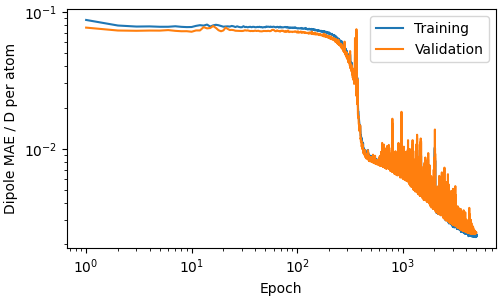
We can monitor convergence by loading the loss log written during training.
train_log = np.genfromtxt(
    "data/train.csv",
    delimiter=",",
    names=True,
    dtype=None,
    encoding="utf-8",
)[1:]

epochs = train_log["Epoch"].astype(float) + 1
train_mae = train_log["training_mttdipole_MAE_per_atom"].astype(float)
val_mae = train_log["validation_mttdipole_MAE_per_atom"].astype(float)

fig, ax = plt.subplots(figsize=(5, 3), constrained_layout=True)
ax.loglog(epochs, train_mae, label="Training")
ax.loglog(epochs, val_mae, label="Validation")
ax.set_xlabel("Epoch")
# the per_atom suffix means metatrain divides by the number of atoms for consistent
# loss scaling; here all frames are the same box of water so it is a constant factor
ax.set_ylabel("Dipole MAE / D per atom")
ax.legend()
<matplotlib.legend.Legend object at 0x7f6323123740>
Model evaluation on the test set
metatrain holds out 5% of the dataset as a test set (test_set: 0.05 in
options.yaml). A representative subset of ten frames from this test set is listed
in data/test.txt. We select the corresponding frames from the full dataset and
write them to disk so that data/eval.yaml can point to them:
ref_frames = ase.io.read("water_mlip_dipole_data.xyz", index=":")
test_idx = np.loadtxt("data/test.txt", dtype=int)

test_set = [ref_frames[i] for i in test_idx]
ase.io.write("test_set.xyz", test_set, format="extxyz")

# Before evaluating the model we export the fine-tuned checkpoint to TorchScript.
# The base checkpoint ``pet-mad-xs-v1.5.0.ckpt`` (also downloaded) is only needed to
# re-run fine-tuning; its path is referenced in ``options.yaml`` under
# ``finetune.read_from``.

run_command(
    "mtt export pet-mad-xs-v1.5.0_SCAN_dipole.ckpt -o pet-mad-xs-v1.5.0_SCAN_dipole.pt",
    print_output=True,
)
/home/runner/work/atomistic-cookbook/atomistic-cookbook/.nox/water-ir-spectrum/lib/python3.12/site-packages/metatrain/utils/omegaconf.py:127: UserWarning: register_new_resolver() is deprecated and will be removed in a future release.
Use register_resolver() instead.
See https://github.com/hydra-ecosystem/omegaconf/issues/426 for migration instructions.

  OmegaConf.register_new_resolver("default_device", default_device)
/home/runner/work/atomistic-cookbook/atomistic-cookbook/.nox/water-ir-spectrum/lib/python3.12/site-packages/metatrain/utils/omegaconf.py:128: UserWarning: register_new_resolver() is deprecated and will be removed in a future release.
Use register_resolver() instead.
See https://github.com/hydra-ecosystem/omegaconf/issues/426 for migration instructions.

  OmegaConf.register_new_resolver("default_precision", default_precision)
/home/runner/work/atomistic-cookbook/atomistic-cookbook/.nox/water-ir-spectrum/lib/python3.12/site-packages/metatrain/utils/omegaconf.py:129: UserWarning: register_new_resolver() is deprecated and will be removed in a future release.
Use register_resolver() instead.
See https://github.com/hydra-ecosystem/omegaconf/issues/426 for migration instructions.

  OmegaConf.register_new_resolver("default_random_seed", lambda: RANDOM_SEED)
[2026-10-19 19:35:41][INFO] - Logging to file is disabled.
[2026-10-19 19:35:41][INFO] - Package version: 2026.4.1
[2026-10-19 19:35:41][INFO] - Package directory: /home/runner/work/atomistic-cookbook/atomistic-cookbook/.nox/water-ir-spectrum/lib/python3.12/site-packages/metatrain
[2026-10-19 19:35:41][INFO] - Working directory: /home/runner/work/atomistic-cookbook/atomistic-cookbook/examples/water-ir-spectrum
[2026-10-19 19:35:41][INFO] - Executed command: mtt export pet-mad-xs-v1.5.0_SCAN_dipole.ckpt -o pet-mad-xs-v1.5.0_SCAN_dipole.pt
[2026-10-19 19:35:41][WARNING] - /home/runner/work/atomistic-cookbook/atomistic-cookbook/.nox/water-ir-spectrum/lib/python3.12/site-packages/torch/jit/_script.py:1488: DeprecationWarning: `torch.jit.script` is deprecated. Please switch to `torch.compile` or `torch.export`.
  warnings.warn(

[2026-10-19 19:35:41][INFO] - Using best model from epoch 4383
[W1019 19:35:41.222259822 quantities.cpp:881] Warning: the 'non_conservative_forces' quantity is deprecated, please update this code to use 'non_conservative_force' instead. (function validate_quantity_name)
[W1019 19:35:41.222298710 model.cpp:345] Warning: 'energy' defines 2 output variants and 'energy' has an empty description. Consider adding meaningful descriptions helping users to distinguish between them. (function set_outputs)
[2026-10-19 19:35:41][WARNING] - /home/runner/work/atomistic-cookbook/atomistic-cookbook/.nox/water-ir-spectrum/lib/python3.12/site-packages/metatrain/pet/model.py:1031: UserWarning: the 'non_conservative_forces' output name is deprecated, please update the model to use 'non_conservative_force' instead
  return AtomisticModel(self.eval(), metadata, capabilities)

[2026-10-19 19:35:41][WARNING] - /home/runner/work/atomistic-cookbook/atomistic-cookbook/.nox/water-ir-spectrum/lib/python3.12/site-packages/torch/jit/_script.py:1488: DeprecationWarning: `torch.jit.script` is deprecated. Please switch to `torch.compile` or `torch.export`.
  warnings.warn(

[2026-10-19 19:35:41][WARNING] - /home/runner/work/atomistic-cookbook/atomistic-cookbook/.nox/water-ir-spectrum/lib/python3.12/site-packages/torch/jit/_serialization.py:89: DeprecationWarning: `torch.jit.save` is deprecated. Please switch to `torch.export`.
  warnings.warn(

[2026-10-19 19:35:41][INFO] - Model exported to '/home/runner/work/atomistic-cookbook/atomistic-cookbook/examples/water-ir-spectrum/pet-mad-xs-v1.5.0_SCAN_dipole.pt'

CompletedProcess(args=['mtt', 'export', 'pet-mad-xs-v1.5.0_SCAN_dipole.ckpt', '-o', 'pet-mad-xs-v1.5.0_SCAN_dipole.pt'], returncode=0, stdout='/home/runner/work/atomistic-cookbook/atomistic-cookbook/.nox/water-ir-spectrum/lib/python3.12/site-packages/metatrain/utils/omegaconf.py:127: UserWarning: register_new_resolver() is deprecated and will be removed in a future release.\nUse register_resolver() instead.\nSee https://github.com/hydra-ecosystem/omegaconf/issues/426 for migration instructions.\n\n  OmegaConf.register_new_resolver("default_device", default_device)\n/home/runner/work/atomistic-cookbook/atomistic-cookbook/.nox/water-ir-spectrum/lib/python3.12/site-packages/metatrain/utils/omegaconf.py:128: UserWarning: register_new_resolver() is deprecated and will be removed in a future release.\nUse register_resolver() instead.\nSee https://github.com/hydra-ecosystem/omegaconf/issues/426 for migration instructions.\n\n  OmegaConf.register_new_resolver("default_precision", default_precision)\n/home/runner/work/atomistic-cookbook/atomistic-cookbook/.nox/water-ir-spectrum/lib/python3.12/site-packages/metatrain/utils/omegaconf.py:129: UserWarning: register_new_resolver() is deprecated and will be removed in a future release.\nUse register_resolver() instead.\nSee https://github.com/hydra-ecosystem/omegaconf/issues/426 for migration instructions.\n\n  OmegaConf.register_new_resolver("default_random_seed", lambda: RANDOM_SEED)\n[2026-10-19 19:35:41][INFO] - Logging to file is disabled.\n[2026-10-19 19:35:41][INFO] - Package version: 2026.4.1\n[2026-10-19 19:35:41][INFO] - Package directory: /home/runner/work/atomistic-cookbook/atomistic-cookbook/.nox/water-ir-spectrum/lib/python3.12/site-packages/metatrain\n[2026-10-19 19:35:41][INFO] - Working directory: /home/runner/work/atomistic-cookbook/atomistic-cookbook/examples/water-ir-spectrum\n[2026-10-19 19:35:41][INFO] - Executed command: mtt export pet-mad-xs-v1.5.0_SCAN_dipole.ckpt -o pet-mad-xs-v1.5.0_SCAN_dipole.pt\n[2026-10-19 19:35:41][WARNING] - /home/runner/work/atomistic-cookbook/atomistic-cookbook/.nox/water-ir-spectrum/lib/python3.12/site-packages/torch/jit/_script.py:1488: DeprecationWarning: `torch.jit.script` is deprecated. Please switch to `torch.compile` or `torch.export`.\n  warnings.warn(\n\n[2026-10-19 19:35:41][INFO] - Using best model from epoch 4383\n[W1019 19:35:41.222259822 quantities.cpp:881] Warning: the \'non_conservative_forces\' quantity is deprecated, please update this code to use \'non_conservative_force\' instead. (function validate_quantity_name)\n[W1019 19:35:41.222298710 model.cpp:345] Warning: \'energy\' defines 2 output variants and \'energy\' has an empty description. Consider adding meaningful descriptions helping users to distinguish between them. (function set_outputs)\n[2026-10-19 19:35:41][WARNING] - /home/runner/work/atomistic-cookbook/atomistic-cookbook/.nox/water-ir-spectrum/lib/python3.12/site-packages/metatrain/pet/model.py:1031: UserWarning: the \'non_conservative_forces\' output name is deprecated, please update the model to use \'non_conservative_force\' instead\n  return AtomisticModel(self.eval(), metadata, capabilities)\n\n[2026-10-19 19:35:41][WARNING] - /home/runner/work/atomistic-cookbook/atomistic-cookbook/.nox/water-ir-spectrum/lib/python3.12/site-packages/torch/jit/_script.py:1488: DeprecationWarning: `torch.jit.script` is deprecated. Please switch to `torch.compile` or `torch.export`.\n  warnings.warn(\n\n[2026-10-19 19:35:41][WARNING] - /home/runner/work/atomistic-cookbook/atomistic-cookbook/.nox/water-ir-spectrum/lib/python3.12/site-packages/torch/jit/_serialization.py:89: DeprecationWarning: `torch.jit.save` is deprecated. Please switch to `torch.export`.\n  warnings.warn(\n\n[2026-10-19 19:35:41][INFO] - Model exported to \'/home/runner/work/atomistic-cookbook/atomistic-cookbook/examples/water-ir-spectrum/pet-mad-xs-v1.5.0_SCAN_dipole.pt\'\n')
data/eval.yaml points to test_set.xyz and restricts the output to the dipole:
run_command(
    "mtt eval pet-mad-xs-v1.5.0_SCAN_dipole.pt data/eval.yaml -o test_set_dipoles.xyz",
    print_output=True,
)

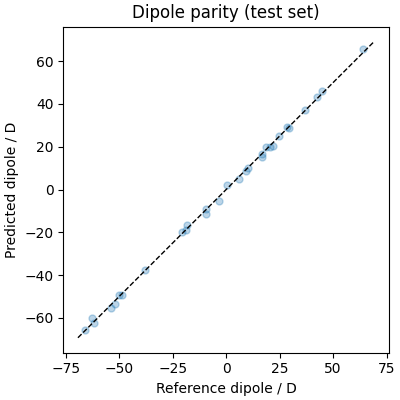
# We load the predictions and visualize a parity plot. Reference dipoles are under
# ``dft_dipole``; model predictions under the ``mtt::dipole`` key, as seen earlier in
# the options file. Each point is one Cartesian component of the cell dipole.

pred_frames = ase.io.read("test_set_dipoles.xyz", index=":")

# mtt::dipole is stored with shape (3, 1); [..., 0] drops the trailing dim to (3,)
pred_dipoles = np.array([f.info["mtt::dipole"][..., 0] for f in pred_frames])
ref_dipoles = np.array([f.info["dft_dipole"] for f in test_set])

fig, ax = plt.subplots(figsize=(4, 4), constrained_layout=True)
ax.set_aspect("equal")
lim = np.abs(ref_dipoles).max() * 1.05
ax.plot(ref_dipoles.flatten(), pred_dipoles.flatten(), ".", alpha=0.3, ms=10)
ax.plot([-lim, lim], [-lim, lim], "k--", lw=1)
ax.set_xlabel("Reference dipole / D")
ax.set_ylabel("Predicted dipole / D")
ax.set_title("Dipole parity (test set)")
/home/runner/work/atomistic-cookbook/atomistic-cookbook/.nox/water-ir-spectrum/lib/python3.12/site-packages/metatrain/utils/omegaconf.py:127: UserWarning: register_new_resolver() is deprecated and will be removed in a future release.
Use register_resolver() instead.
See https://github.com/hydra-ecosystem/omegaconf/issues/426 for migration instructions.

  OmegaConf.register_new_resolver("default_device", default_device)
/home/runner/work/atomistic-cookbook/atomistic-cookbook/.nox/water-ir-spectrum/lib/python3.12/site-packages/metatrain/utils/omegaconf.py:128: UserWarning: register_new_resolver() is deprecated and will be removed in a future release.
Use register_resolver() instead.
See https://github.com/hydra-ecosystem/omegaconf/issues/426 for migration instructions.

  OmegaConf.register_new_resolver("default_precision", default_precision)
/home/runner/work/atomistic-cookbook/atomistic-cookbook/.nox/water-ir-spectrum/lib/python3.12/site-packages/metatrain/utils/omegaconf.py:129: UserWarning: register_new_resolver() is deprecated and will be removed in a future release.
Use register_resolver() instead.
See https://github.com/hydra-ecosystem/omegaconf/issues/426 for migration instructions.

  OmegaConf.register_new_resolver("default_random_seed", lambda: RANDOM_SEED)
[2026-10-19 19:35:43][INFO] - Logging to file is disabled.
[2026-10-19 19:35:43][INFO] - Package version: 2026.4.1
[2026-10-19 19:35:43][INFO] - Package directory: /home/runner/work/atomistic-cookbook/atomistic-cookbook/.nox/water-ir-spectrum/lib/python3.12/site-packages/metatrain
[2026-10-19 19:35:43][INFO] - Working directory: /home/runner/work/atomistic-cookbook/atomistic-cookbook/examples/water-ir-spectrum
[2026-10-19 19:35:43][INFO] - Executed command: mtt eval pet-mad-xs-v1.5.0_SCAN_dipole.pt data/eval.yaml -o test_set_dipoles.xyz
[2026-10-19 19:35:43][WARNING] - /home/runner/work/atomistic-cookbook/atomistic-cookbook/.nox/water-ir-spectrum/lib/python3.12/site-packages/torch/jit/_serialization.py:176: DeprecationWarning: `torch.jit.load` is deprecated. Please switch to `torch.export`.
  warnings.warn(

[W1019 19:35:43.761377016 model.cpp:345] Warning: 'energy' defines 2 output variants and 'energy' has an empty description. Consider adding meaningful descriptions helping users to distinguish between them. (function set_outputs)
[2026-10-19 19:35:43][WARNING] - /home/runner/work/atomistic-cookbook/atomistic-cookbook/.nox/water-ir-spectrum/lib/python3.12/site-packages/metatomic/torch/model.py:75: UserWarning: the 'non_conservative_forces' output name is deprecated, please update the model to use 'non_conservative_force' instead
  return AtomisticModel(model, model.metadata(), model.capabilities())

[2026-10-19 19:35:43][INFO] - Setting up evaluation set.
[2026-10-19 19:35:43][INFO] - Evaluating dataset
[2026-10-19 19:35:44][WARNING] - /home/runner/work/atomistic-cookbook/atomistic-cookbook/.nox/water-ir-spectrum/lib/python3.12/site-packages/ase/atoms.py:432: DeprecationWarning: Setting the shape on a NumPy array has been deprecated in NumPy 2.5.
As an alternative, you can create a new view using np.reshape (with copy=False if needed).
  a.shape = (-1,) + shape

[2026-10-19 19:35:44][WARNING] - /home/runner/work/atomistic-cookbook/atomistic-cookbook/.nox/water-ir-spectrum/lib/python3.12/site-packages/torch/jit/_fuser.py:169: DeprecationWarning: `torch.jit.set_fusion_strategy` is deprecated. Please use `torch.compile` instead.
  warnings.warn(

[2026-10-19 19:35:44][INFO] - Running on device cpu with dtype torch.float32
[2026-10-19 19:35:44][INFO] - Warming up the model with 10 batches...

  0%|                                                                        | 0/10 [00:00<?, ?it/s][2026-10-19 19:35:46][WARNING] - /home/runner/work/atomistic-cookbook/atomistic-cookbook/.nox/water-ir-spectrum/lib/python3.12/site-packages/ase/atoms.py:432: DeprecationWarning: Setting the shape on a NumPy array has been deprecated in NumPy 2.5.
As an alternative, you can create a new view using np.reshape (with copy=False if needed).
  a.shape = (-1,) + shape


 10%|██████▍                                                         | 1/10 [00:00<00:01,  5.90it/s][2026-10-19 19:35:46][WARNING] - /home/runner/work/atomistic-cookbook/atomistic-cookbook/.nox/water-ir-spectrum/lib/python3.12/site-packages/ase/atoms.py:432: DeprecationWarning: Setting the shape on a NumPy array has been deprecated in NumPy 2.5.
As an alternative, you can create a new view using np.reshape (with copy=False if needed).
  a.shape = (-1,) + shape


 20%|████████████▊                                                   | 2/10 [00:00<00:01,  5.71it/s][2026-10-19 19:35:47][WARNING] - /home/runner/work/atomistic-cookbook/atomistic-cookbook/.nox/water-ir-spectrum/lib/python3.12/site-packages/ase/atoms.py:432: DeprecationWarning: Setting the shape on a NumPy array has been deprecated in NumPy 2.5.
As an alternative, you can create a new view using np.reshape (with copy=False if needed).
  a.shape = (-1,) + shape


 30%|███████████████████▏                                            | 3/10 [00:00<00:01,  5.14it/s][2026-10-19 19:35:47][WARNING] - /home/runner/work/atomistic-cookbook/atomistic-cookbook/.nox/water-ir-spectrum/lib/python3.12/site-packages/ase/atoms.py:432: DeprecationWarning: Setting the shape on a NumPy array has been deprecated in NumPy 2.5.
As an alternative, you can create a new view using np.reshape (with copy=False if needed).
  a.shape = (-1,) + shape


 40%|█████████████████████████▌                                      | 4/10 [00:00<00:01,  5.67it/s][2026-10-19 19:35:47][WARNING] - /home/runner/work/atomistic-cookbook/atomistic-cookbook/.nox/water-ir-spectrum/lib/python3.12/site-packages/ase/atoms.py:432: DeprecationWarning: Setting the shape on a NumPy array has been deprecated in NumPy 2.5.
As an alternative, you can create a new view using np.reshape (with copy=False if needed).
  a.shape = (-1,) + shape


 50%|████████████████████████████████                                | 5/10 [00:00<00:00,  5.78it/s][2026-10-19 19:35:47][WARNING] - /home/runner/work/atomistic-cookbook/atomistic-cookbook/.nox/water-ir-spectrum/lib/python3.12/site-packages/ase/atoms.py:432: DeprecationWarning: Setting the shape on a NumPy array has been deprecated in NumPy 2.5.
As an alternative, you can create a new view using np.reshape (with copy=False if needed).
  a.shape = (-1,) + shape


 60%|██████████████████████████████████████▍                         | 6/10 [00:01<00:00,  5.99it/s][2026-10-19 19:35:47][WARNING] - /home/runner/work/atomistic-cookbook/atomistic-cookbook/.nox/water-ir-spectrum/lib/python3.12/site-packages/ase/atoms.py:432: DeprecationWarning: Setting the shape on a NumPy array has been deprecated in NumPy 2.5.
As an alternative, you can create a new view using np.reshape (with copy=False if needed).
  a.shape = (-1,) + shape


 70%|████████████████████████████████████████████▊                   | 7/10 [00:01<00:00,  5.98it/s][2026-10-19 19:35:47][WARNING] - /home/runner/work/atomistic-cookbook/atomistic-cookbook/.nox/water-ir-spectrum/lib/python3.12/site-packages/ase/atoms.py:432: DeprecationWarning: Setting the shape on a NumPy array has been deprecated in NumPy 2.5.
As an alternative, you can create a new view using np.reshape (with copy=False if needed).
  a.shape = (-1,) + shape


 80%|███████████████████████████████████████████████████▏            | 8/10 [00:01<00:00,  6.25it/s][2026-10-19 19:35:48][WARNING] - /home/runner/work/atomistic-cookbook/atomistic-cookbook/.nox/water-ir-spectrum/lib/python3.12/site-packages/ase/atoms.py:432: DeprecationWarning: Setting the shape on a NumPy array has been deprecated in NumPy 2.5.
As an alternative, you can create a new view using np.reshape (with copy=False if needed).
  a.shape = (-1,) + shape


 90%|█████████████████████████████████████████████████████████▌      | 9/10 [00:01<00:00,  6.32it/s][2026-10-19 19:35:48][WARNING] - /home/runner/work/atomistic-cookbook/atomistic-cookbook/.nox/water-ir-spectrum/lib/python3.12/site-packages/ase/atoms.py:432: DeprecationWarning: Setting the shape on a NumPy array has been deprecated in NumPy 2.5.
As an alternative, you can create a new view using np.reshape (with copy=False if needed).
  a.shape = (-1,) + shape


100%|███████████████████████████████████████████████████████████████| 10/10 [00:01<00:00,  6.53it/s]
100%|███████████████████████████████████████████████████████████████| 10/10 [00:01<00:00,  6.08it/s]
[2026-10-19 19:35:48][INFO] - mtt::dipole RMSE (per atom): 0.0030978 | mtt::dipole MAE (per atom): 0.0025115
[2026-10-19 19:35:48][INFO] - Evaluation time: 1.26 s [0.3286 ± 0.0430 ms per atom]

Text(0.5, 1.0, 'Dipole parity (test set)')
We can also visualize the predicted and reference dipole arrows side by side on all test frames (green = reference, orange = predicted).
test_frames = [ref_frames[i].copy() for i in test_idx]
for f, mu_ref, mu_pred in zip(test_frames, ref_dipoles, pred_dipoles):
    f.info["dipole_ref"] = mu_ref
    f.info["dipole_pred"] = mu_pred

arrows_ref = chemiscope.ase_vectors_to_arrows(test_frames, "dipole_ref", scale=0.1)
arrows_ref["parameters"]["global"]["color"] = "green"

arrows_pred = chemiscope.ase_vectors_to_arrows(test_frames, "dipole_pred", scale=0.1)
arrows_pred["parameters"]["global"]["color"] = "orange"

chemiscope.show(
    test_frames,
    shapes={"reference": arrows_ref, "predicted": arrows_pred},
    mode="structure",
    settings=chemiscope.quick_settings(
        trajectory=True,
        structure_settings={"shape": ["reference", "predicted"], "unitCell": True},
    ),
)
How equivariant is the dipole head?
As discussed above, PET does not enforce rotation equivariance by construction, but it learns it via data augmentation. The residual error can be quantified directly: take a test frame, apply \(N\) Haar-uniform random rotations \(R\), predict the dipole on each rotated copy, and back-rotate the predictions to the original orientation:
If the model were exactly equivariant, all \(\tilde{\boldsymbol{\mu}}_R\) would coincide. Any spread is the equivariance error.
To evaluate the model directly in Python (rather than through mtt eval as we did
above) we wrap it in a MetatomicCalculator, which exposes any model output as an
ASE calculator quantity. We request mtt::dipole as an additional output
alongside the energy.
dipole_request = {
    "mtt::dipole": ModelOutput(
        quantity="",  # unused, as the dipole is not a "standard output" in metatomic
        unit="",  # unused, as the dipole is not a "standard output" in metatomic
        sample_kind="system",
        explicit_gradients=[],
    )
}
calc_eq = MetatomicCalculator(
    "pet-mad-xs-v1.5.0_SCAN_dipole.pt",
    additional_outputs=dipole_request,
    device="cpu",
)


def predict_dipole(atoms: ase.Atoms) -> np.ndarray:
    """Run the model on ``atoms`` and return the predicted dipole (3,)."""
    atoms.calc = calc_eq
    atoms.get_potential_energy()  # ASE runs one forward pass for any property
    block = calc_eq.additional_outputs["mtt::dipole"].block(0)
    return block.values.detach().cpu().numpy()[0, :, 0]
/home/runner/work/atomistic-cookbook/atomistic-cookbook/.nox/water-ir-spectrum/lib/python3.12/site-packages/metatomic/torch/model.py:75: UserWarning: the 'non_conservative_forces' output name is deprecated, please update the model to use 'non_conservative_force' instead
  return AtomisticModel(model, model.metadata(), model.capabilities())
We use a held-out test frame (not seen during training) so the measurement reflects how well the learned equivariance generalizes to unseen structures (note that, even though the frame is not used during training, it contains the same number of molecules, so it is not strictly out of distribution).
frame_eq = ref_frames[test_idx[0]].copy()

n_rot = 32
rots = Rotation.random(n_rot, random_state=0)

back_rotated = []
for R in rots:
    Rmat = R.as_matrix()
    fR = frame_eq.copy()
    fR.positions = fR.positions @ Rmat.T
    fR.cell = np.asarray(fR.cell) @ Rmat.T
    mu_R = predict_dipole(fR)
    back_rotated.append(Rmat.T @ mu_R)

back_rotated = np.array(back_rotated)
mu_mean = back_rotated.mean(axis=0)
err_per_rot = np.linalg.norm(back_rotated - mu_mean, axis=1)
rel_err = 100.0 * err_per_rot / np.linalg.norm(mu_mean)

mu_ref_eq = np.array(frame_eq.info["dft_dipole"])
model_err = np.linalg.norm(mu_mean - mu_ref_eq)

print(f"|<mu_back>|           = {np.linalg.norm(mu_mean):.3f} D")
print(
    f"mean ||delta_mu||    = {err_per_rot.mean():.3f} D "
    f"({rel_err.mean():.1f} % of the mean dipole)"
)
print(f"||mu_mean - mu_ref|| = {model_err:.3f} D  (model error on this frame)")
|<mu_back>|           = 42.871 D
mean ||delta_mu||    = 1.069 D (2.5 % of the mean dipole)
||mu_mean - mu_ref|| = 1.313 D  (model error on this frame)
A few-percent residual is consistent with what one expects from an unconstrained model trained with rotational data augmentation. To put it in perspective, we also compare the spread to the model’s actual error on this frame—the distance between the mean back-rotated prediction (our proxy for the equivariant result) and the DFT reference. If the equivariance error is small compared to the model error, the lack of equivariance is not the bottleneck, and enforcing it exactly would not meaningfully improve accuracy. Note that the spread measures rotational consistency, not baseline accuracy: it would be zero for an exactly equivariant model regardless of how far that model is from the DFT reference.
To see the equivariance error directly, we repeat the same protocol on a single (isolated) water molecule and overlay the resulting cloud of back-rotated dipoles on the molecule. The blue arrows are the individual \(\tilde{\boldsymbol{\mu}}_R\), the orange one their mean. The tighter the blue cluster around the orange arrow, the closer the model is to exact equivariance.
water_iso = ase.build.molecule("H2O")
water_iso.center(about=water_iso.get_center_of_mass())

back_iso = []
for R in Rotation.random(n_rot, random_state=1):
    Rmat = R.as_matrix()
    fR = water_iso.copy()
    fR.positions = fR.positions @ Rmat.T
    back_iso.append(Rmat.T @ predict_dipole(fR))

back_iso = np.array(back_iso)
mu_iso_mean = back_iso.mean(axis=0)

shapes_eq = {}
for i, mu in enumerate(back_iso):
    shapes_eq[f"sample_{i}"] = {
        "kind": "arrow",
        "parameters": {
            "global": {
                "baseRadius": 0.03,
                "headRadius": 0.05,
                "headLength": 0.06,
                "color": "blue",
            },
            "structure": [{"vector": [0.5 * float(v) for v in mu]}],
        },
    }
shapes_eq["mean"] = {
    "kind": "arrow",
    "parameters": {
        "global": {
            "baseRadius": 0.06,
            "headRadius": 0.10,
            "headLength": 0.12,
            "color": "orange",
        },
        "structure": [{"vector": [0.5 * float(v) for v in mu_iso_mean]}],
    },
}

chemiscope.show(
    [water_iso],
    shapes=shapes_eq,
    mode="structure",
    settings=chemiscope.quick_settings(
        structure_settings={"rotation": True, "shape": list(shapes_eq.keys())},
    ),
)
MD simulation with the joint model
The point-charge baseline used a TIP3P trajectory, so its peak positions reflect the TIP3P force field. To obtain dynamics governed by the DFT-quality potential-energy surface, we run a new trajectory driven by the fine-tuned joint model.
We use LAMMPS for this. First we generate a LAMMPS data file to be used as initial
frame for the MLIP run from the last frame of the TIP3P trajectory (a 15.6 Å cubic box
at ~1 g/cm³). The type map follows the TIP3P dump: type 1 = O, type 2 = H;
pair_coeff * * 8 1 passes atomic numbers Z=8 (O) and Z=1 (H) to the model
accordingly.
initial_frame_mlip = traj_pc[-1].copy()
initial_frame_mlip.wrap()
ase.io.write(
    "water.data", initial_frame_mlip, format="lammps-data", atom_style="atomic"
)
The LAMMPS input mirrors the TIP3P setup: 1 ps NVT equilibration followed by 5 ps
production at 330 K with the Bussi CSVR thermostat, saving snapshots every 2 fs.
SCAN-level water is slightly over-structured compared to experiment; running at 330 K
compensates, bringing the liquid dynamics closer to room-temperature behaviour.
variant scan is required to select the fine-tuned energy head of the joint
model; without it LAMMPS would use the base PET-MAD head instead:
units metal
atom_style atomic

variable seed       index 24680
variable t_target   equal 330.0
variable tdamp      equal 100*dt
variable nequil     equal 2000     # 1 ps @ 0.5 fs
variable nprod      equal 10000    # 5 ps @ 0.5 fs
variable dump_every equal 4        # dump every 2 fs (= 4 * 0.5 fs)

read_data water.data
mass 1 15.999
mass 2 1.008

pair_style metatomic pet-mad-xs-v1.5.0_SCAN_dipole.pt device cpu variant scan
pair_coeff * * 8 1

timestep 0.0005   # 0.5 fs in metal (ps)
neighbor 2.0 bin
neigh_modify one 100000 page 1000000 binsize 5.5

thermo_style custom step temp press etotal pe ke
thermo 1000

velocity all create ${t_target} ${seed} mom yes rot yes
reset_timestep 0

fix nve_int   all nve
fix thermostat all temp/csvr ${t_target} ${t_target} ${tdamp} ${seed}
run ${nequil}

dump traj all custom ${dump_every} pet-xs-scan.lammpstrj id type xu yu zu
dump_modify traj sort id
run ${nprod}
Note
The pre-run trajectory is provided in pet-xs-scan.lammpstrj (downloaded above);
the LAMMPS run is shown for reference only (it takes several minutes on a GPU):
lmp -in in_metatomic.lmp
We load the pre-run trajectory and restore chemical symbols from the type map (type 1 = O, type 2 = H).
type_map = {1: "O", 2: "H"}
traj_ml = ase.io.read("pet-xs-scan.lammpstrj", index=":", format="lammps-dump-text")
for atoms in traj_ml:
    atoms.set_chemical_symbols([type_map[int(t)] for t in atoms.arrays["type"]])
    atoms.set_pbc(True)
To evaluate dipoles we need to pass the trajectory through mtt eval. That
command requires a reference target in the dataset to restrict its output to a single
property (mtt::dipole); without one it would compute and store all targets the
model was trained on (energy, forces, dipole), producing a much larger file. We write
placeholder zeros, and disregard the accuracy report output by metatrain.
for atoms in traj_ml:
    atoms.info["dft_dipole"] = np.zeros(3)

ase.io.write("pet-xs-scan.xyz", traj_ml, format="extxyz")
We also write the evaluation config, which mirrors the dataset section of
options.yaml but restricts the target to the dipole only:
traj_eval_yaml = {
    "systems": {
        "read_from": "pet-xs-scan.xyz",
        "reader": "ase",
        "length_unit": "angstrom",
    },
    "targets": {
        "mtt::dipole": {
            "reader": "ase",
            "key": "dft_dipole",  # placeholder: restricts output to dipole only
            "type": {"cartesian": {"rank": 1}},
        }
    },
}
with open("traj_eval.yaml", "w") as fh:
    yaml.dump(traj_eval_yaml, fh)
Finally we run the evaluation to get the dipole time series for the whole trajectory.
The -b 64 flag batches the evaluation on 64 frames at a time, which speeds it up
compared to the default of one frame at a time. Depending on the available memory,
this batch size might be too large, or even larger batch sizes may be possible.
Warning
Dipole evaluation on the whole trajectory takes a few minutes on a GPU. The
pre-computed output is provided in ml_traj_dipoles.xyz (downloaded above).
mtt eval pet-mad-xs-v1.5.0_SCAN_dipole.pt traj_eval.yaml -o ml_traj_dipoles.xyz -b
64
IR spectrum from the ML dipole model
We load the pre-computed dipole predictions and convert from Debye to e·Å (1 D = 3.33564×10⁻³⁰ C·m; 1 e·Å = 1.602×10⁻¹⁹ C × 10⁻¹⁰ m).
dipole_frames = ase.io.read("ml_traj_dipoles.xyz", index=":")
# mtt eval stores dipoles as shape (3, 1); drop the trailing axis to get (3,)
ml_timeseries = np.array([f.info["mtt::dipole"][..., 0] for f in dipole_frames])

D_TO_EA = 3.33564e-30 / (1.602176634e-19 * 1e-10)
ml_volume_A3 = dipole_frames[0].get_volume()
freqs_ml, alpha_ml = ir_spectrum(
    ml_timeseries * D_TO_EA, DT_FS, ml_volume_A3, temperature_K=330.0
)
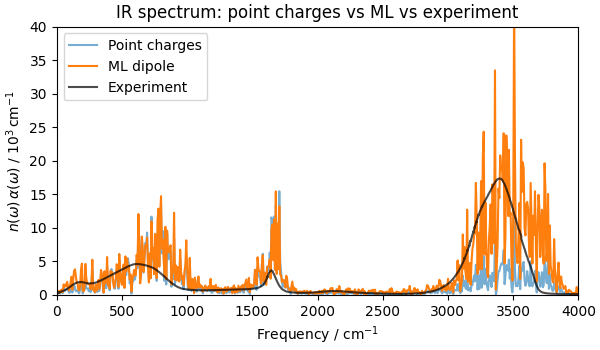
To isolate the dipole model’s contribution from the force field’s, we recompute the fixed-charge dipole on the same ML trajectory. Because the prefactor carries no empirical constants, both spectra are in absolute units and can be compared to experiment directly. Any difference between the two curves then reflects the dipole model alone. Note that this point-charge curve will look slightly different from the baseline earlier in the recipe, as that one used the TIP3P trajectory, which gives different peak positions.
pc_timeseries = np.array([compute_pc_dipole(f) for f in dipole_frames])
freqs_pc, alpha_pc = ir_spectrum(
    pc_timeseries, DT_FS, ml_volume_A3, temperature_K=330.0
)

fig, ax = plt.subplots(figsize=(6, 3.5), constrained_layout=True)
ax.plot(freqs_pc, alpha_pc, alpha=0.6, label="Point charges")
ax.plot(freqs_ml, alpha_ml, label="ML dipole")
ax.plot(expt[:, 0], expt[:, 1], "k-", alpha=0.7, label="Experiment")
ax.set_xlim(0, 4000)
ax.set_ylim(0, 40)
ax.set_xlabel(r"Frequency / cm$^{-1}$")
ax.set_ylabel(r"$n(\omega)\,\alpha(\omega)$ / $10^3\,\mathrm{cm}^{-1}$")
ax.legend()
ax.set_title("IR spectrum: point charges vs ML vs experiment")
Text(0.5, 1.0, 'IR spectrum: point charges vs ML vs experiment')
The MLIP dynamics alone shifts and broadens the peaks relative to the TIP3P baseline, improving agreement with experimental data. The main contribution of the ML dipole model is to correct the intensities, especially for the O–H stretch and the bending modes.
The main lesson is that the failure modes of fixed partial charges are systematic: they follow from the absence of charge flux, not from a poor choice of charge value, and cannot be remedied by tuning one scalar parameter. An ML dipole model trained on a few hundred DFT snapshots already recovers much of the missing physics.
Total running time of the script: (2 minutes 52.867 seconds)