Note
Go to the end to download the full example code.
Phonon dispersions with committee uncertainty using kALDo
- Authors:
Giuseppe Barbalinardo @gbarbalinardo
This recipe computes a phonon dispersion with an uncertainty estimate directly
in kALDo, using its
PhononsEnsemble API together with the
PET-MAD universal machine-learning
potential via the UPET calculator.
This is a companion to the phonon dispersions with uncertainty recipe by Paolo Pegolo and Michele Ceriotti, which computes committee-based phonon uncertainties with uqphonon (a wrapper around phonopy and i-PI). Here we show the same idea evaluated entirely within kALDo: kALDo builds the force constants and the phonon spectrum for each committee member and aggregates them, so no additional phonon backend is needed.
The companion recipe uses a shallow ensemble (Kellner and Ceriotti, 2024): committee
members that share all weights except the last layer, obtained through the
last-layer prediction rigidity framework (LLPR, Bigi et al., 2024; see also the PET-MAD UQ recipe), which
gives a calibrated uncertainty. Here the committee is instead two independent
PET-MAD models (XS and S) that do not share weights: the spread is a rougher,
uncalibrated measure of model disagreement, but it exercises the same
PhononsEnsemble machinery and keeps the example dependent only on kALDo and
UPET. For a calibrated committee, use uqphonon as in the companion recipe.
The theory and implementation of kALDo are described in Barbalinardo et al., J. Appl. Phys. 128, 135104 (2020).
We use silicon (diamond) as a test system.
Note
The supercell and displacement settings used here are deliberately small so the recipe runs in CI in a few minutes. Larger supercells give better-converged dispersions.
import numpy as np
import matplotlib.pyplot as plt
from ase.build import bulk
from ase.constraints import FixSymmetry
from ase.filters import StrainFilter
from ase.optimize import BFGS

from upet.calculator import UPETCalculator
from kaldo.ensemble import PhononsEnsemble
from kaldo.observables.harmonic_with_q import HarmonicWithQ
/home/runner/work/atomistic-cookbook/atomistic-cookbook/.nox/kaldo-phonons-uq/lib/python3.12/site-packages/torch/jit/_script.py:1643: FutureWarning: `torch.jit.interface` is deprecated. Please use `torch.compile` instead.
  warnings.warn(
/home/runner/work/atomistic-cookbook/atomistic-cookbook/.nox/kaldo-phonons-uq/lib/python3.12/site-packages/torch/jit/_script.py:1491: FutureWarning: `torch.jit.script` is deprecated. Please switch to `torch.compile` or `torch.export`.
  warnings.warn(
Warp 1.18.0 initialized:
   CUDA Toolkit 13.4, CUDA driver not available (NVRTC compilation available)
   Devices:
     "cpu"      : "x86_64"
   Kernel cache:
     /home/runner/.cache/warp/1.18.0
/home/runner/work/atomistic-cookbook/atomistic-cookbook/examples/kaldo-phonons-uq/kaldo-phonons-uq.py:57: DeprecationWarning: upet.calculator is deprecated; use `from upet.ase import UPETCalculator` and `from upet.ase.dos import PETMADDOSCalculator` instead.
  from upet.calculator import UPETCalculator
Setup
We build a small committee from two PET-MAD variants, the extra-small (XS) and
small (S) models. Treating independent models as committee members gives a
rougher uncertainty estimate than a calibrated LLPR committee, but it keeps the
example dependent only on kALDo and UPET. See the companion pet-phonons
recipe for the calibrated-committee workflow.
DEVICE = "cpu"
SUPERCELL = (3, 3, 3)
KPTS = (5, 5, 5)
DELTA = 3e-2  # Angstrom, finite-difference displacement

members = [
    UPETCalculator(model="pet-mad-xs", device=DEVICE, dtype="float32", version="1.5.0"),
    UPETCalculator(model="pet-mad-s", device=DEVICE, dtype="float32", version="1.5.0"),
]
Warning: You are sending unauthenticated requests to the HF Hub. Please set a HF_TOKEN to enable higher rate limits and faster downloads.
WARNING:huggingface_hub.utils._http:Warning: You are sending unauthenticated requests to the HF Hub. Please set a HF_TOKEN to enable higher rate limits and faster downloads.
/home/runner/work/atomistic-cookbook/atomistic-cookbook/.nox/kaldo-phonons-uq/lib/python3.12/site-packages/torch/jit/_script.py:1491: FutureWarning: `torch.jit.script` is deprecated. Please switch to `torch.compile` or `torch.export`.
  warnings.warn(
/home/runner/work/atomistic-cookbook/atomistic-cookbook/.nox/kaldo-phonons-uq/lib/python3.12/site-packages/torch/jit/_script.py:1491: FutureWarning: `torch.jit.script` is deprecated. Please switch to `torch.compile` or `torch.export`.
  warnings.warn(
/home/runner/work/atomistic-cookbook/atomistic-cookbook/.nox/kaldo-phonons-uq/lib/python3.12/site-packages/torch/jit/_script.py:1491: FutureWarning: `torch.jit.script` is deprecated. Please switch to `torch.compile` or `torch.export`.
  warnings.warn(
/home/runner/work/atomistic-cookbook/atomistic-cookbook/.nox/kaldo-phonons-uq/lib/python3.12/site-packages/torch/jit/_script.py:1491: FutureWarning: `torch.jit.script` is deprecated. Please switch to `torch.compile` or `torch.export`.
  warnings.warn(
/home/runner/work/atomistic-cookbook/atomistic-cookbook/.nox/kaldo-phonons-uq/lib/python3.12/site-packages/torch/jit/_script.py:1491: FutureWarning: `torch.jit.script` is deprecated. Please switch to `torch.compile` or `torch.export`.
  warnings.warn(
Relaxation
We relax the silicon cell with the first model, keeping the diamond symmetry
with FixSymmetry. Unconstrained machine-learning potentials only respect
the crystal symmetry approximately, so constraining the relaxation avoids a
spuriously symmetry-broken cell. StrainFilter relaxes only the cell
degrees of freedom: with FixSymmetry the atoms stay on the fixed Wyckoff
sites of the diamond lattice, so the lattice parameter is the only variable.
atoms = bulk("Si", "diamond", a=5.43)
atoms.calc = members[0]
atoms.set_constraint(FixSymmetry(atoms))
BFGS(StrainFilter(atoms), logfile=None).run(fmax=1e-4)
atoms.set_constraint(None)
print(f"Optimized lattice parameter: {atoms.cell.cellpar()[0]:.3f} A")
Optimized lattice parameter: 3.842 A
Ensemble force constants and phonons
PhononsEnsemble.from_calculators runs a finite-difference second-order
calculation for each committee member, projects each set of force constants
onto the space-group-invariant subspace (symmetrize=True), and builds a
Phonons object per member. The symmetrization is important with
unconstrained models: it removes the small symmetry violations that would
otherwise break degeneracies near \(\Gamma\), so the uncertainty band
reflects genuine model disagreement rather than symmetry-breaking noise.
ensemble = PhononsEnsemble.from_calculators(
    atoms,
    SUPERCELL,
    members,
    delta_shift=DELTA,
    symmetrize=True,
    kpts=KPTS,
    temperature=300,
    storage="memory",
)

mean, std = ensemble.mean_std("frequency")
print(f"ensemble members: {ensemble.n_members}")
print(f"max frequency std over the k-point mesh: {std.max():.3f} THz")
2026-10-19 19:35:28,823 - kaldo - INFO - Calculating second order potential derivatives, finite difference displacement: 3.000e-02 angstrom
INFO:kaldo:Calculating second order potential derivatives, finite difference displacement: 3.000e-02 angstrom
2026-10-19 19:35:29,384 - kaldo - INFO - Symmetry of Dynamical Matrix 0.0029798752317814065
INFO:kaldo:Symmetry of Dynamical Matrix 0.0029798752317814065
2026-10-19 19:35:29,393 - kaldo - INFO - Space group: Fd-3m (#227), 48 unit-cell ops, 48 compatible with supercell shape (3, 3, 3)
INFO:kaldo:Space group: Fd-3m (#227), 48 unit-cell ops, 48 compatible with supercell shape (3, 3, 3)
2026-10-19 19:35:29,405 - kaldo - INFO - Calculating second order potential derivatives, finite difference displacement: 3.000e-02 angstrom
INFO:kaldo:Calculating second order potential derivatives, finite difference displacement: 3.000e-02 angstrom
2026-10-19 19:35:34,210 - kaldo - INFO - Symmetry of Dynamical Matrix 0.0028678526480983776
INFO:kaldo:Symmetry of Dynamical Matrix 0.0028678526480983776
2026-10-19 19:35:34,218 - kaldo - INFO - Space group: Fd-3m (#227), 48 unit-cell ops, 48 compatible with supercell shape (3, 3, 3)
INFO:kaldo:Space group: Fd-3m (#227), 48 unit-cell ops, 48 compatible with supercell shape (3, 3, 3)
ensemble members: 2
max frequency std over the k-point mesh: 0.776 THz
Dispersion with an uncertainty band
Each member is an ordinary kALDo Phonons object, so we evaluate its
frequencies at each \(\mathbf{q}\)-point along a high-symmetry path and
plot the mean band structure with a shaded plus/minus standard-deviation
envelope per branch.
X = np.array([0.5, 0.0, 0.5])
G = np.array([0.0, 0.0, 0.0])
L = np.array([0.5, 0.5, 0.5])
n_seg = 60
path = [X + (G - X) * t for t in np.linspace(0, 1, n_seg)] + [
    G + (L - G) * t for t in np.linspace(0, 1, n_seg)[1:]
]
x_axis = np.concatenate([np.linspace(0, 1, n_seg), 1 + np.linspace(0, 1, n_seg)[1:]])


def member_bands(phonons):
    """Frequencies (n_q, n_modes) of one member along the q-path."""
    return np.array(
        [
            HarmonicWithQ(
                np.asarray(q), phonons.forceconstants.second, storage="memory"
            ).frequency.flatten()
            for q in path
        ]
    )


bands = np.array([member_bands(m) for m in ensemble.members])
band_mean = bands.mean(axis=0)
band_std = bands.std(axis=0)

fig, ax = plt.subplots(figsize=(7, 5))
color = "tab:blue"
for b in range(band_mean.shape[1]):
    ax.plot(x_axis, band_mean[:, b], color=color, lw=1.6)
    ax.fill_between(
        x_axis,
        band_mean[:, b] - band_std[:, b],
        band_mean[:, b] + band_std[:, b],
        color=color,
        alpha=0.25,
        linewidth=0,
    )
ax.axhline(0, color="k", lw=0.6, alpha=0.5)
ax.axvline(1, color="k", lw=0.6, alpha=0.5)
ax.set_xticks([0, 1, 2])
ax.set_xticklabels(["X", r"$\Gamma$", "L"])
ax.set_xlim(0, 2)
ax.set_ylabel("Frequency (THz)")
ax.set_title(r"Si phonon dispersion, PET-MAD committee (mean $\pm$ std)")
plt.tight_layout()
plt.show()
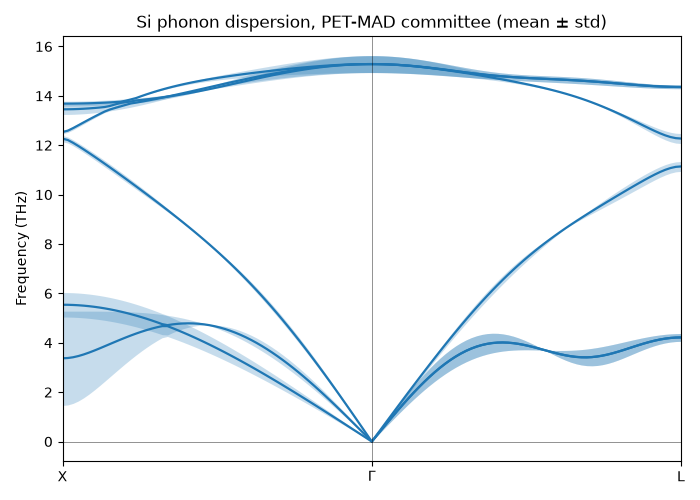
The shaded band widens where the two models disagree most (the upper optical
branches and along \(\Gamma\)-L), and collapses toward the acoustic sum
rule at \(\Gamma\), where all three acoustic branches go to zero. For a
production-quality uncertainty estimate, replace the two independent models
with a calibrated LLPR committee as shown in the pet-phonons recipe, and
increase the supercell size.
Total running time of the script: (0 minutes 19.981 seconds)